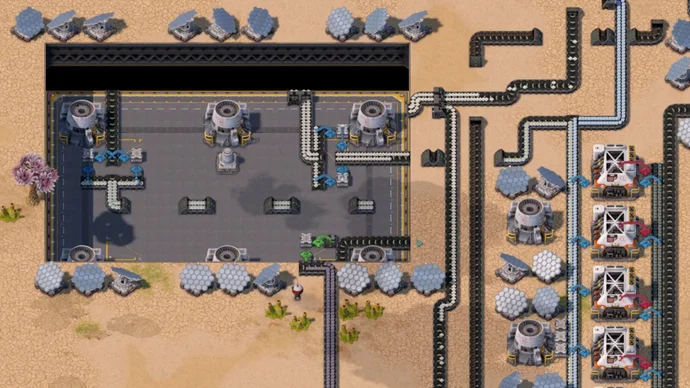
At first glance, Substructure immediately reads as another Factorio-style factory builder. Top-down view, resource mining, conveyor belts, assembly chains, blueprint tools — all the familiar factory-building vocabulary is there. But dig past the surface aesthetic, and you’ll find mechanics that rewrite the rulebook for automation games. As many beta testers put it: some players love these bold changes, while others find them deeply frustrating.
The familiar shell: Why it looks like Factorio
Substructure is built by Stu Taylor, best known for Factorio’s massive Ultracube mod, so the visual and mechanical lineage is obvious. You mine raw materials, feed them into machines, build longer production chains, and chase higher throughput. The UI, blueprint system, and construction logic all feel instantly recognizable for veteran factory fans.
But this is not just another Factorio mod reskinned into a standalone release. The core design goal is to avoid the classic automation trap: simply building bigger and wider factories to solve every bottleneck. Instead, Substructure pushes you downward, into multi-layer underground levels.
The biggest shift: vertical multi-level factory design
Factorio is a purely horizontal game. You expand outward across a flat 2D plane. Space is a problem you solve by claiming more land.
Substructure turns that idea upside down. Your factory can stack across many separate layers connected by programmable lifts. Resources live on different depths. Ores found deep underground feed machines on the surface, and surface-made components travel back down to build deeper infrastructure.
Lifts become your new bottleneck. They are not just fast teleport tubes. You must schedule material flow between levels, manage lift capacity, and design your production chains with vertical logistics in mind. A factory that works perfectly on one floor can collapse if your lift throughput cannot keep up.
This is the game’s defining puzzle. Instead of sprawling endlessly across the map, you learn to stack and coordinate production across depth layers. For many players, this fresh spatial puzzle is brilliant. But others hate it: juggling multiple levels adds cognitive overhead, and debugging a broken cross-layer supply chain is far more complex than tracing a conveyor belt on a single flat map.
Decentralized power: another divisive core change
Most factory automation games use a simple power grid: build generators, run power poles, and every connected machine draws power from the shared network. If total power demand exceeds supply, everything slows or stops.
Substructure replaces that centralized grid with decentralized power. Machines do not pull power from a universal global network. Power generation and consumption are local, which completely changes how you plan your factory.
You can’t just plop a giant bank of power plants in one corner and wire your whole base. Every section of your factory needs its own local power solution. This forces you to think about power distribution early and everywhere. Fans praise this for making every zone design meaningful; detractors argue it adds tedious, repetitive overhead to every new production block. This is exactly where that split sentiment comes from — some people love it, some people are annoyed by it.
The design philosophy: scaling out is not always the answer
Traditional factory sims reward expansion. If your throughput is too low, add more miners, more furnaces, more assembly lines. More machines = more output.
Substructure’s design fights against that mindset. Simply adding more copies of a machine will not automatically fix your bottlenecks. You need smarter routing, better lift scheduling, and cross-layer resource balancing. The game wants you to optimize systems rather than just brute-force scale.
This makes it more of a logistics puzzle and less of a relaxed incremental factory builder. If you enjoy the meditative “just build more” loop of Factorio, this shift can feel restrictive. If you crave tougher, more layered engineering challenges, Substructure hits differently.
What still feels great
- Blueprint support: You can copy factory sections and deploy them, with construction arms handling placement.
- Co-op multiplayer: Build your vertical industrial empire with friends.
- Progressive exploration: Dig deeper toward the planet’s core, unlocking new resources that upgrade older surface infrastructure.
- Clean top-down visuals that make large factories readable, even across multiple layers.
The pain points that annoy some players
- Cross-layer debugging is harder. Tracking a missing component across multiple underground levels is much trickier than following a single-plane conveyor line.
- Decentralized power adds extra planning work to every new factory module.
- The learning curve is steeper. Factorio veterans can’t rely entirely on their old habits; familiar factory instincts often lead to dead ends.
- Lift throughput is a constant limiting factor, and lift scheduling can feel finicky and unforgiving.
Who should play Substructure
✅ Pick it up if you:
- Want a factory sim focused on vertical, multi-level logistics puzzles
- Enjoy system engineering and complex bottleneck troubleshooting
- Loved Ultracube and crave challenging, non-trivial automation problems
- Are ready to unlearn some Factorio habits
❌ Skip it for now if you:
- Prefer relaxed, wide horizontal factory expansion
- Hate juggling multiple overlapping layers of logistics
- Want simple centralized power grids and straightforward conveyor line debugging
Final thoughts
Substructure wears Factorio’s visual style on its sleeve, but under the hood it rewrites two foundational automation rules: factory layout and power distribution. The vertical multi-layer system and decentralized power split the player base sharply. Some players find its fresh engineering challenges thrilling, while others grow annoyed by its extra layers of complexity.
This is not “Factorio but underground.” It is a factory builder that actively pushes back against the genre’s default “expand outward” mindset. If you’re ready to rethink how you design automated production lines, Substructure offers one of the most interesting twists on the automation formula in years.