Midjourney v7 Review: Still the King of AI Image Generation?
Executive Summary
Generative image competition has intensified, with FLUX, DALL-E 4 and Adobe Firefly all refining artistic quality, prompt adherence and controllability. This independent technical assessment evaluates Midjourney v7, Midjourney’s flagship image foundation model. Benchmarking was conducted over three weeks, measuring visual fidelity, anatomical consistency, reference preservation, prompt interpretation, creative workflow capabilities and commercial licensing terms, to assess whether Midjourney retains its market-leading position for concept artists, designers and creative agencies.
Evaluation Methodology
Testing was conducted across five weighted assessment dimensions. Standardized prompt sets and reference assets were used for side-by-side benchmarking against FLUX 2 Pro, DALL‑E 4 and Adobe Firefly 3. Test cases covered photorealistic portraiture, cinematic concept art, product renders, illustrative artwork and stylized editorial visuals.
- Visual Aesthetics & Texture Fidelity (30%)
- Anatomy, Character & Object Consistency (25%)
- Prompt Interpretation & Creative Controllability (20%)
- Platform Workflow, Editor & Feature Set (15%)
- Subscription Pricing & Commercial Value (10%)
Platform Overview & Core Capabilities
Midjourney v7 is built on a rebuilt diffusion architecture, addressing persistent limitations of prior iterations, most notably anatomical distortion, inconsistent character likeness and slow iterative workflow. The headline addition is Omni Reference, a reference system that preserves subject identity across lighting changes, camera angles and pose variations. Designers upload a single reference image of a character, product or object, and the model retains core visual characteristics across dozens of renders, resolving one of the largest workflow pain points for character and product design teams.
A second major upgrade is Draft Mode. Draft Mode generates low-resolution preview renders at approximately 10x speed and half GPU-hour cost. This feature drastically lowers the cost of exploratory ideation, allowing creators to rapidly test compositions, lighting and stylistic directions before committing GPU resources to high-fidelity final outputs.
The release also delivers a fully functional native web interface, eliminating the historic requirement to operate exclusively inside Discord. The web workspace supports image uploads, prompt editing, inpainting, outpainting, upscaling and retexturing. Additional functionality includes personalization profiles; after rating a small sample of generated images, the platform learns a creator’s aesthetic preferences and biases outputs toward their preferred visual style.
Other integrated capabilities:
- Native image-to-short-video generation for 5–21 second cinematic motion clips
- Vary Region localized inpainting for targeted image revision
- Retexture tool for surface material replacement while preserving underlying geometry
- Personalization toggle to disable taste-biased generation for neutral, objective renders
Performance Assessment
Visual Aesthetics & Texture Fidelity (Score:9.2/10)
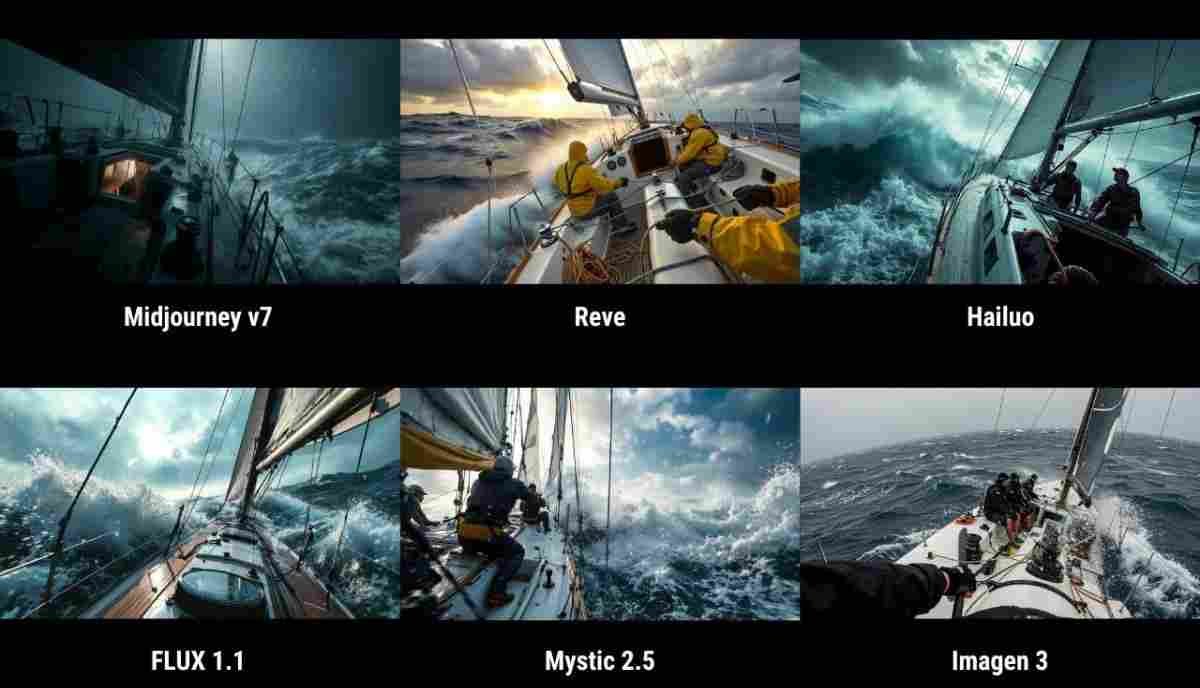
This is where Midjourney v7 continues to establish its market advantage. The model renders complex materials, lighting, depth of field and color grading with a cinematic cohesion competitors struggle to match. Whether photorealistic photography, oil painting, surreal concept scenes or editorial fashion imagery, outputs carry deliberate composition, natural lighting falloff and rich micro-details such as fabric folds, skin texture, stone grain and reflective surfaces.
In benchmark comparisons, FLUX and Firefly deliver technically clean images, but their default aesthetic lacks the intentional artistic mood and atmospheric depth native to Midjourney v7. The primary limitation: extremely subtle micro-details under unusual lighting can occasionally lose definition in heavily stylized artistic modes.
Anatomy, Character & Object Consistency (Score:8.9/10)
v7 delivers substantial improvements to hands, fingers, facial proportions and human anatomy. Omni Reference enables stable character retention across pose and lighting shifts. For product designers, the tool maintains consistent form, material and branding for product mockups across different environments and lighting setups.
Limitations remain in highly complex multi-character scenes. When three or more characters interact with overlapping limbs and complex motion, minor anatomical inconsistencies can still appear.
Prompt Interpretation & Creative Controllability (Score:8.5/10)
Midjourney v7 demonstrates major gains in understanding multi-part, descriptive prompts, reliably interpreting complex lighting, camera lens parameters and artistic style instructions. It excels at capturing abstract mood and conceptual direction rather than only literal object placement.
The main weakness is precise spatial control. Placing multiple objects in pixel-exact predefined positions remains difficult. In addition, embedded text rendering inside generated artwork is improved but inconsistent. Short text phrases may render correctly, while longer copy or multi-line typography frequently contains garbled characters.
Platform Workflow & Editor Tooling (Score:8.7/10)
The new web editor is a meaningful workflow upgrade. Creators no longer need to juggle Discord bot commands and external editing software. Inpainting, outpainting and retexturing all live within the browser environment. Version management and asset libraries help organize iterative creative exploration.
The API gap remains a notable limitation. There is no public API for embedding Midjourney generation inside custom applications, automation pipelines or internal studio tools. This restricts integration for engineering and product teams building custom creative tooling.
Subscription Pricing & Commercial Value (Score:7.8/10)
Midjourney operates on GPU-hour based subscription tiers. There is no free tier or free trial, requiring payment before any testing.
- Basic ($10/month): ~3.3 GPU hours, suitable for casual concept exploration
- Standard ($30/month): 15 GPU hours plus unlimited Relax Mode, the recommended tier for freelancers and creative agencies
- Pro ($60/month): 30 GPU hours plus Stealth Mode for private, confidential client work
- Mega ($120/month): 60 GPU hours for high-volume creative studios
Annual billing offers a 20% discount. Commercial usage rights are included on all tiers, though businesses with annual revenue exceeding $1M must subscribe to Pro or higher.
Strengths & Limitations
Core Advantages
- Unmatched baseline artistic quality, cinematic lighting and atmospheric depth for creative visual work.
- Omni Reference delivers robust character and product consistency across lighting and camera variations.
- Draft Mode reduces cost and speeds up rapid ideation and concept exploration.
- Native web editor removes Discord dependency and consolidates revision workflows.
- Improved anatomy and hand rendering reduce wasted iterations and revision cycles.
- Integrated image-to-video generation extends creative workflows from static image to motion preview.
Key Constraints
- No free trial or free tier, requiring upfront subscription cost for evaluation.
- Weak native text rendering for typography-heavy graphic design work.
- Limited precise spatial layout control for exact object positioning.
- No public API, restricting integration into custom automation and application workflows.
- Stealth Mode (private generation) is locked behind the higher-cost Pro subscription.
- Generated images are public by default on Basic and Standard plans unless upgraded.
Competitive Benchmark Comparison
Midjourney v7 vs FLUX 2 Pro FLUX provides superior technical control and supports self-hosted local deployment, making it ideal for teams prioritizing data privacy and custom fine-tuning. However, its default aesthetic quality is less refined. FLUX suits technical, customizable workflows, while Midjourney delivers superior artistic beauty and emotional atmosphere.
Midjourney v7 vs DALL‑E 4 (ChatGPT) DALL‑E 4 delivers stronger text rendering and stricter literal prompt adherence, integrated seamlessly within ChatGPT workflows. Midjourney creates more visually immersive, artistic imagery, while DALL‑E is preferable for graphics requiring embedded readable text.
Midjourney v7 vs Adobe Firefly 3 Firefly offers the lowest copyright risk and native integration with Adobe Creative Cloud. Its range of artistic styles is narrower. Firefly is best for enterprise brand teams working inside Adobe’s ecosystem; Midjourney is preferred for original concept art and creative exploration.
Use-Case Alignment
Midjourney v7 is optimized for concept artists, illustrators, marketing agencies, creative directors, game studios and motion designers generating concept art, marketing visuals, editorial imagery, product renders and cinematic storyboard art. It delivers maximum ROI for creative work prioritizing aesthetic impact, mood and visual storytelling.
Alternatives should be considered under these scenarios:
- Design assets requiring significant embedded readable text: Ideogram or DALL‑E 4 are more reliable.
- Teams requiring self-hosting, data isolation and API integration: FLUX 2 Pro is a better fit.
- Low-budget casual experimentation with no upfront subscription budget: Leonardo AI offers limited free credits.
Final Verdict
Overall Score:9.0/10 The competitive landscape has never been more crowded. FLUX, DALL‑E and Firefly have narrowed the technical gap in many areas. Even so, for pure artistic quality, cinematic composition and gallery-ready visual atmosphere, Midjourney v7 remains the king of AI image generation.
It carries meaningful tradeoffs: no free trial, unreliable text rendering and limited precise spatial control are tangible compromises. Still, for professional artists, designers and creative agencies prioritizing stunning, evocative visuals, no competing platform matches Midjourney’s aesthetic quality, reference consistency and end-to-end creative workflow.
For creative professionals pursuing high-quality concept art, marketing imagery and visual storytelling, Midjourney v7 remains the primary recommendation for AI image generation in 2026.
Have you integrated Midjourney v7 into your creative pipeline? Which workflows have benefited most from Omni Reference and Draft Mode? Share your observations in the comments section.